Free interactive courses

Finally understand the code you use every day

Unravel Code turns the hard parts of programming into narrated, step-by-step animations. Watch real code run, predict what happens next, and see exactly why.

Start the event loop course →

No sign-up. Open it and press play.

Live from the course
23interactive sections in the first course
56 minof narration, read along word by word
100×runs on real Node for the tricky challenges
Freeno account, no paywall
Sound familiar?

Most of us just hope the code does what we think

Debugging at 1 amWhy does this print A, C, B? The delay is 0!
Reading the docs, againI've read this page three times and I still couldn't draw it.
Shipping a fixI wrapped it in setTimeout and now it works. No idea why.
Fighting the compilerThe borrow checker says no, so I clone everything.
In the interviewI know what a hash map is. I just can't explain why it's fast.

It isn't that you're not smart enough. These things are invisible: they happen where you can't see, faster than you can follow, so you end up memorising rules instead of understanding them.

Why Unravel Code

Reading about invisible things is hard. So we make them visible.

Every course slows real code down until you can see each step: what runs, what waits, and what moves where. A narrator talks you through it while the stage animates every move.

✓

Checked against the real thing

Every example is run on the real runtime before it ships. When the output can vary, the course says so and accepts every order Node can actually print.

⟲

Fact-checked twice

Each course goes through two separate fact-check reviews, and every correction lands in both the text and the narration.

▶

Made for watching, not skimming

Narration with word-by-word highlighting, animations synced to the words, and steps you can pause and replay as often as you like.

How it works

Three steps, every topic

1

Pick a topic

Start with the Node.js event loop. Data structures, Rust's borrow checker and HTTP servers are next.

2

Watch it run

Real code runs one step at a time while the narrator explains what moved and why.

3

Predict, then check

Labs and challenges ask what happens next. Make your call, then watch the real answer play out.

Courses

Start with the one everybody gets wrong

One course is out now and more are on the way. Each one turns a topic people usually just read about into something you can step through.
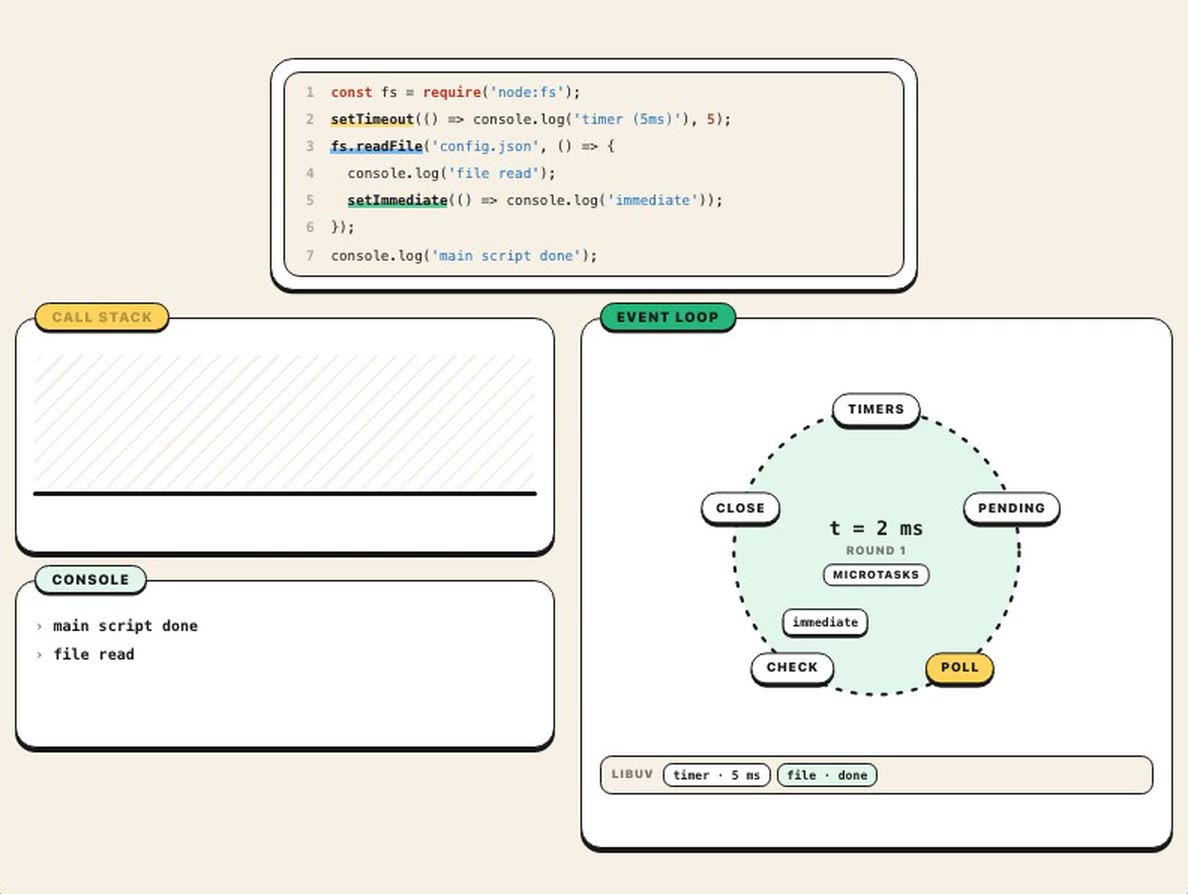
The event loop stage: code, the phase wheel, the call stack and the console
Available now · Free

The Node.js event loop

Why does setTimeout(fn, 0) run last? One thread, libuv, the queues, microtasks and the five loop phases, then labs on the cases that trip people up.

8 lessons7 labs8 challenges56 min narrated
Start the course →
[ ]Planned

Data structures

Arrays, linked lists, hash maps and trees, built up one operation at a time so you can see why each one is fast or slow.

&Planned

Rust's borrow checker

Ownership, borrows and lifetimes, drawn out so you can see exactly why the compiler says no.

/Planned

HTTP servers, under the hood

From a TCP socket to a parsed request and back: what a server does with every byte.

?Idea

What should be next?

Anything in programming that is easier to see than to read about is a candidate.

What changes

Stop guessing. Start knowing why.

Keep guessing

Without a picture in your head

  • ✕Copy-paste fixes you can't explain in code review.
  • ✕Bugs that only show up in production, under load.
  • ✕Interview answers you hope are right.
  • ✕Rules you re-learn every time you need them.
With Unravel Code

When you can see it run

  • ✓You predict what your code will do before you run it.
  • ✓You debug by reasoning, not by trial and error.
  • ✓You explain it clearly to your team, or your interviewer.
  • ✓It sticks, because you saw it, not just read it.

See how it really works

The event loop course is free and takes about an hour. Start with the first lesson and go at your own pace.